
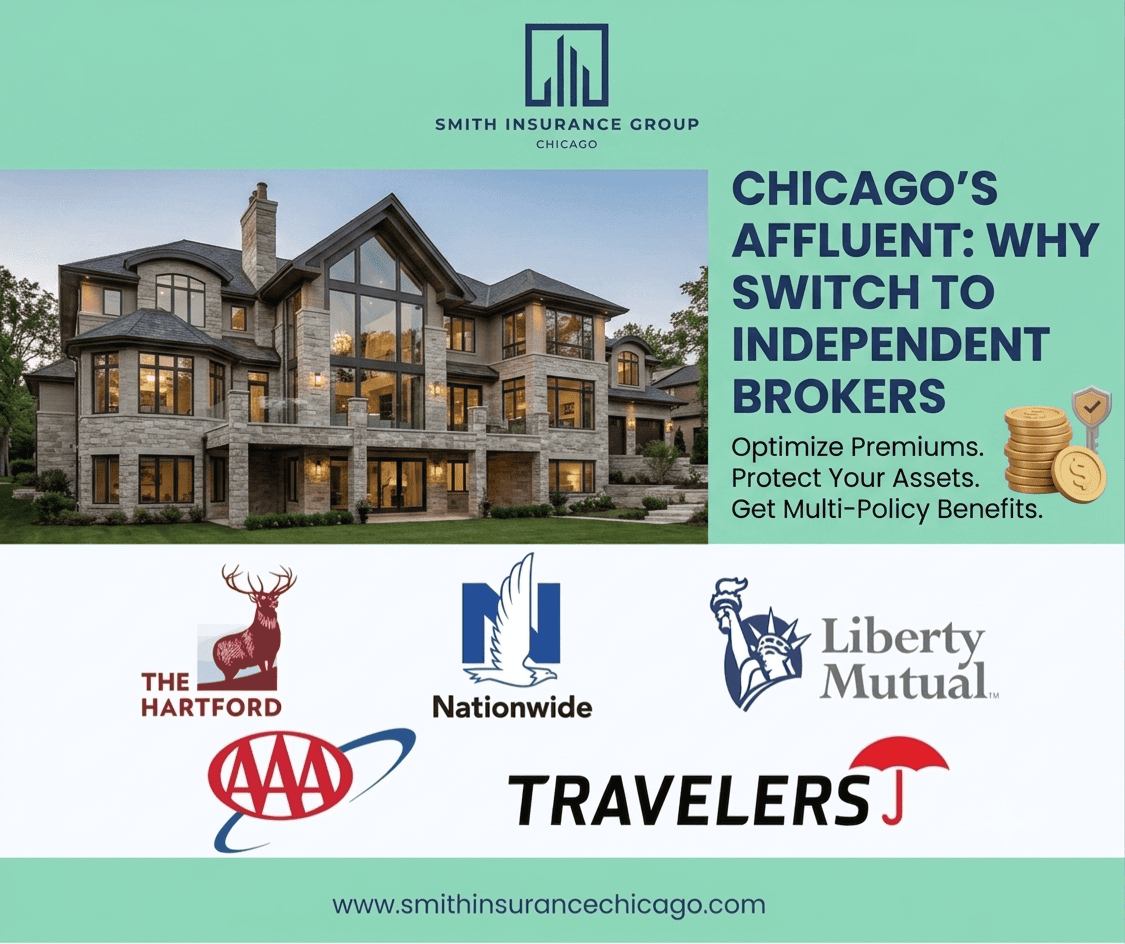
If you own a historic home in the North Shore, a high-rise condo in the Gold Coast, or a growing portfolio of assets across Cook County, you’ve likely noticed a massive shift in the insurance landscape recently. Premium hikes, sudden carrier pullbacks, and stricter underwriting standards have turned what used to be a simple annual renewal into a complex financial hurdle.
Because of this, high-net-worth individuals (HNWIs) across Chicagoland are quietly walking away from traditional, “captive” insurance agents (who represent a single brand) and moving toward independent brokers.
The reason isn’t just about finding a lower price—it’s about a fundamental shift from buying a standard policy to implementing true wealth protection. Here is why Chicago’s affluent families are making the switch.
1. Navigating a Constrained “Hard” Market
The insurance industry is currently facing an incredibly tight market. Driven by consecutive years of historic climate losses, inflation in construction costs, and a tightening reinsurance market, traditional carriers are scaling back their appetites.
Many affluent homeowners are finding that standard admitted carriers are refusing to renew policies on high-value properties or are introducing restrictive sub-limits on things like water damage or mold remediation. Because an independent broker isn’t tied to a single company, they have access to the Excess & Surplus (E&S) market. E&S carriers specialize in unique, high-value, or complex risks that traditional insurers won’t touch, ensuring your assets stay continuously protected even when mainstream options contract.
2. Standard Policies vs. True High-Value Coverage
A common trap for successful families is relying on a standard “HO3” homeowners policy that has simply been beefed up with a few endorsements or riders. For a multi-million dollar property, a standard contract is often fundamentally inadequate.
Independent brokers work with specialized premier carriers who understand the nuances of high-end builds. Instead of generic calculations, they utilize precise, specialized valuations that account for custom cabinetry, architectural details, and historic materials common in Chicago’s premier neighborhoods.
Critical Gap: According to recent private client market research, cybercrime losses targeting high-net-worth households now exceed $12 billion annually. Standard home insurance rarely accounts for sophisticated digital fraud, identity theft, or online extortion—exposures that require dedicated personal cyber policies.
3. The Move From Transactional Sales to Strategic Risk Partnership
A direct insurance writer is incentivized to sell you a pre-packaged product. In contrast, an independent broker acts as an advisor, looking at your entire balance sheet to find vulnerabilities.
Instead of just handing you a bill, a dedicated broker builds a proactive risk-mitigation framework. This includes advising on physical resilience measures—such as centrally monitored security systems or advanced smart water-detection sensors—which not only protect your property from devastating losses but also make your profile highly attractive to premium underwriters.
Protecting What You’ve Built
Your insurance portfolio shouldn’t be treated as a static, set-it-and-forget-it expense. As your investments, real estate holdings, and lifestyle evolve, your coverage needs to actively mirror that growth. Switching to an independent broker gives you an advocate whose primary loyalty is to your financial security, not an insurance company’s corporate mandate.
If you’d like to learn more about how shifting dynamics and regional factors are altering local premium structures, you can check out this report on Illinois Insurance Rate Shifts (https://www.youtube.com/watch?v=oLV0e-BPsto). This video is highly relevant as it breaks down how evolving local criteria and neighborhood assessments are directly influencing insurance costs across the Chicago metro area.